
Preparing Multi-State U.S. Documents for Kuwait
Preparing U.S. documents for use in Kuwait can become more complicated when the documents were issued or notarized in different states. Each state has its own procedures for certifying public records and notarized documents, and the correct authentication authority depends on where the document originated.
Because Kuwait is not a member of the Hague Apostille Convention, U.S. documents generally require a full authentication and embassy legalization process rather than an apostille alone. Organizing documents by issuing state and identifying the correct authentication route helps prevent avoidable delays and submission problems.
Why the State Where a Document Was Issued Matters
State-issued documents must generally be authenticated by the designated authority in the state where they were issued. This may be the Secretary of State or another authorized state office.
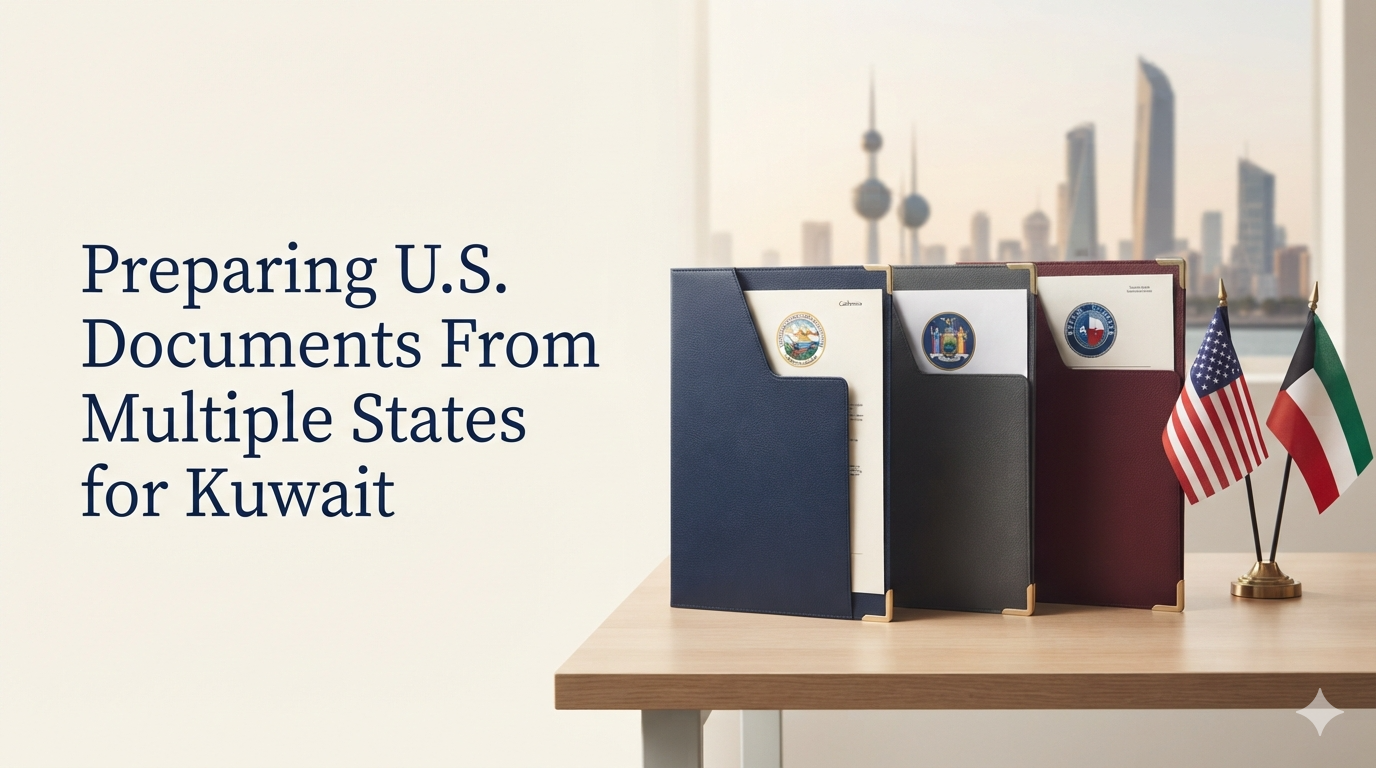
For example, a birth certificate issued in California and a marriage certificate issued in New York must each follow the applicable authentication requirements of their respective states. Having both documents notarized or submitted in another state does not automatically make that state responsible for authenticating them.
The same principle applies to notarized documents. A document notarized in one state may need certification from the authority responsible for that notary's commission before it can proceed to the next authentication stage.
Identify the Correct Authentication Route for Each Document
Before submitting a group of documents, identify how each one was created and which government office issued or certified it.
Common document categories include:
State-issued vital records: Birth, marriage, death, and divorce certificates generally require certification through the issuing state's designated authority.
Notarized documents: Powers of attorney, affidavits, and declarations may require verification of the notary's signature and commission through the appropriate state office.
Court-issued records: Court orders and other judicial records may require certification by the court clerk or another authorized official before state authentication.
Federal documents: FBI background checks and other federal agency records follow a federal authentication route through the U.S. Department of State rather than the state-level process.
A document's title alone does not determine its authentication route. The issuing authority, signature, seal, and document format all matter.
How to Organize Documents From Multiple States
A practical way to manage a multi-state document package is to review each document separately before arranging authentication.
Create a document inventory. List every document, its purpose in Kuwait, the state or federal agency that issued it, and the state where it was notarized, if applicable.
Check the receiving authority's requirements. Confirm which documents are required, whether original or certified copies are acceptable, and whether translations or specific formats are needed.
Group documents by issuing state. Separate documents from different states so each can be directed to the correct authentication office.
Verify certification requirements. Check whether a document needs a certified copy, clerk certification, notarial verification, or another preliminary step.
Identify federal documents separately. Do not send federal records through a state Secretary of State office when they require federal authentication.
Prepare the package for the next stage. Once the required state-level or federal authentication is complete, arrange the remaining U.S. Department of State and Kuwait Embassy legalization steps as applicable.
How the Kuwait Legalization Process Works
For many U.S. state-issued documents intended for official use in Kuwait, the process involves several stages:
State-level authentication: The appropriate state authority verifies the signature or seal on the document or the preceding certification.
U.S. Department of State authentication: The federal office authenticates the relevant state official's signature or seal.
Kuwait Embassy legalization: The Embassy of Kuwait in Washington, D.C., authenticates the U.S. Department of State certification for use in Kuwait.
Federal documents follow a different initial route. They generally proceed through the U.S. Department of State without first going through a state Secretary of State office.
The exact steps can vary according to the document type and how it was issued. Confirm the applicable requirements before sending original documents or arranging the final submission.
Common Problems When Documents Come From Different States
Multi-state submissions can encounter delays when documents are prepared using the wrong state's procedures or when required certifications are missing.
Common problems include:
Using the wrong state authentication office: A Secretary of State generally cannot authenticate documents issued or notarized under another state's authority.
Submitting an uncertified copy: Some authorities require an original or properly certified document rather than an ordinary photocopy.
Missing preliminary certification: Court records and notarized documents may need an additional certification before the Secretary of State can authenticate them.
Mixing state and federal documents: Federal records require a different authentication route from state-issued documents.
Overlooking translation requirements: The receiving Kuwaiti authority may require an Arabic translation or other language-related preparation.
Assuming every document follows the same process: A single package may contain documents that require different initial authentication steps.
Reviewing each document before submission can help identify these issues early.
Preparing a Complete Document Package for Kuwait
Before sending documents for authentication and legalization, make sure the package is organized and each document has been reviewed individually.
Use this checklist:
Confirm the purpose of each document in Kuwait.
Verify that the receiving authority accepts the document's format.
Identify the state or federal agency that issued each document.
Confirm where each notarization took place.
Obtain required original or certified copies.
Complete any required state-level certification.
Separate federal documents from state-issued records.
Check translation and formatting requirements.
Confirm the remaining U.S. Department of State and Kuwait Embassy submission requirements.
A clear inventory and properly prepared documents make it easier to manage the different authentication routes involved in a multi-state submission.
Frequently Asked Questions
Can documents issued in different U.S. states be legalized together for Kuwait?
They may be coordinated as one overall submission, but each document must first meet the authentication requirements of the state or federal authority responsible for it. Documents from different states may therefore need separate initial processing.
Can one state's Secretary of State authenticate a document issued in another state?
Generally, no. State authentication offices typically verify documents connected to officials, agencies, or notaries within their own jurisdiction. Contact the issuing state's designated authority for the correct procedure.
Do federal documents need state authentication before the U.S. Department of State?
No. Federal documents generally follow the federal authentication route directly. An FBI background check, for example, is not authenticated by a state Secretary of State.
Is an apostille sufficient for documents intended for Kuwait?
No. Kuwait is not a member of the Hague Apostille Convention. Documents intended for official use in Kuwait generally require authentication and legalization through the applicable U.S. authorities and the Kuwait Embassy.
Should all documents be submitted to the Kuwait Embassy at the same time?
That depends on the documents and the Embassy's current submission requirements. Each document must have the required preceding certifications before it is submitted for embassy legalization. Confirm the applicable requirements for the complete package before arranging submission.